


Table of Contents
- Why Fake Beauty Products Are a Real Risk
- Step 1: Inspect the Packaging, Label and Print Quality
- Step 2: Compare Color, Scent and Texture
- How to Tell If Skincare Is Fake: Seals, Tamper Evidence and Ingredients
- How to Check If Makeup Is Authentic: Batch Codes, QR Codes and Serial Numbers
- Using a Beauty Product Batch Code Checker
- Where to Buy Authentic Beauty Products Online
- What to Do If You Bought a Suspected Counterfeit
- Frequently Asked Questions
Last Updated: October 18, 2026
Why Fake Beauty Products Are a Real Risk
Counterfeit beauty products are one of the fastest-growing problems in online shopping, and the stakes go beyond wasted money.
This guide walks you through a seven-step check you can run before you buy or after a parcel arrives: inspecting packaging, comparing color and texture, checking seals, verifying batch codes, checking the seller, and handling a fake that slips through.
Most guides tell you to "trust your gut" and stop there. Counterfeits have gotten good, and gut feeling is not a test. You need a repeatable process.
Step 1: Inspect the Packaging, Label and Print Quality
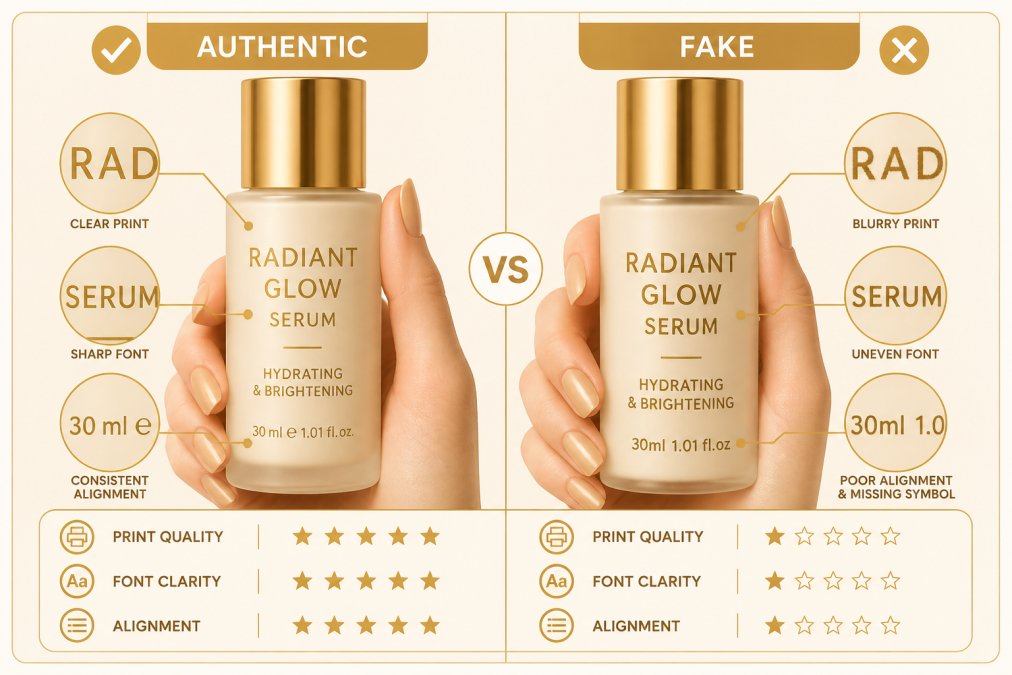
Start with the box and bottle, because packaging is where fakes cut corners first. Real brands invest heavily in print quality; counterfeiters do not.
Pick up the product and look closely at the label under good light:
- Print sharpness: Blurry text, fuzzy edges, or uneven ink are red flags.
- Label alignment: A crooked label or bubbles under the sticker suggest a rushed copy.
- Material feel: Thin, flimsy plastic or a lightweight bottle that feels hollow.
Spelling, Fonts and Logo Details That Give Fakes Away
Read every word on the label, including the fine print. Counterfeiters often misspell brand names, ingredient names, or country-of-origin lines. Look for a stretched or off-center logo, inconsistent fonts between box and bottle, garbled ingredient lists, and no contact address or a fake-looking website. Check the back panel and bottle base too, that is where counterfeiters skip details.
Step 2: Compare Color, Scent and Texture
Your senses catch what the label hides. Open the product and compare it to the real thing or to official product images online.
Watch for these differences in fake beauty products:
- Color: A shade that looks off, muddy, or darker than the shade name suggests.
- Scent: A sharp chemical smell, an overly strong perfume, or no scent where there should be one.
- Texture: A chalky, sticky, rough, thin, or greasy feel that does not match the real formula.
A fake cream may separate, look watery, or feel gritty; a fake lipstick may drag instead of gliding. These texture clues are among the fastest ways to spot a counterfeit.
How to Tell If Skincare Is Fake: Seals, Tamper Evidence and Ingredients
A genuine skincare product arrives sealed, and that seal should be intact. How to tell if skincare is fake comes down to three checks: the seal, the tamper evidence, and the ingredient list.
- Product seal: A broken, missing, or poorly glued seal is a serious warning.
- Tamper evidence: Shrink wrap that looks re-applied, or a cap that has clearly been opened.
- Ingredients: Compare the ingredient list on the pack with the official list from the brand. Fakes often omit preservatives or list ingredients in the wrong order.
If the seal is broken on arrival, treat the product as suspect even if everything else looks right. Tampered goods can be refilled with something else entirely.
How to Check If Makeup Is Authentic: Batch Codes, QR Codes and Serial Numbers
Every genuine product carries a product identifier, your strongest verification tool. To check if makeup is authentic, find the batch code, serial number, or QR code on the pack, then verify it against the brand's own records rather than the seller's word.
Here is where to look:
- The base of the bottle or jar
- The crimp of a lipstick or mascara tube
- The inside of the box flap
A batch code is a short string of letters and numbers identifying when and where a product was made. A serial number is unique to a single unit. A QR code may link to the brand's official verification page.
How to Verify a Batch Code
A batch code is a manufacturing reference, not a secret. Verification means matching that reference to the brand's own data.
- Locate the code on the pack or bottle. It is usually 4-10 characters, often stamped or laser-etched rather than printed.
- Record it exactly, including case and any separators. A single swapped character changes the result.
- Check the brand's official site first. Many brands publish a batch-code lookup or a contact form for authenticity questions. This is the only authoritative source.
- Use a third-party checker as a secondary signal, not a verdict. These tools decode manufacture dates from brand-specific formats, and their databases are incomplete.
- Compare the manufacture date to the seller's claim and to the product's shelf life. A cream manufactured years before you bought it is either expired or mislabeled, both are reasons to stop.
A common pattern: a fake carries a batch code copied from a real product. The code may resolve correctly, but the format, stamp depth, or placement will not match the brand's known layout. That mismatch is the tell.
How to Verify a QR Code
A QR code is only as trustworthy as the destination it opens. Counterfeiters increasingly print codes leading to lookalike pages designed to reassure you.
- Scan it with your phone's camera, not a seller-provided app.
- Read the URL before you tap anything. A genuine brand verification page sits on the brand's own domain. A string of random characters, a URL shortener, or a domain that mimics the brand with an extra word or hyphen is a red flag.
- Check whether the page asks for personal data. A real authenticity check does not need your payment details or account password.
How to Verify a Serial Number
Serial numbers are unit-level identifiers, most common on higher-value items such as fragrance, devices, and limited-edition sets. Verification usually means contacting the brand's customer service with the number and seller's details. A serial number the brand cannot match to a produced unit is a strong signal of a fake, but absence of one is not proof, because not every brand uses them.
What to Do When the Check Is Inconclusive
A "not found" result is common and not automatic proof of a fake. Online checkers rely on incomplete databases, and some brands publish no public lookup. When a check is inconclusive:
- Do not treat the product as verified. Inconclusive means unverified, not safe.
- Contact the brand directly with photos of the pack, the code, and your receipt.
- Cross-check the seller using the workflow in the next section. A verified-looking code from an unauthorized seller is still a risk.
Using a Beauty Product Batch Code Checker
A beauty product batch code checker decodes the manufacturing date from a product's batch code. Enter the code and brand, and it tells you when the item was produced.
- Find the batch code on the pack.
- Enter the code and brand into the checker.
- Note the manufacture date and compare it to the seller's claim.
- Cross-check the result on the brand's own site if possible.
Online checkers rely on incomplete databases, and a "not found" result is not automatic proof of a fake. Use the checker as one signal among several, not a final verdict.
Where to Buy Authentic Beauty Products Online
The safest way to avoid fakes is to control where you shop. Where to buy authentic beauty products online comes down to choosing sellers you can verify, with the same discipline you apply to the product.
Buy from the brand's own website or an authorized seller listed by the brand. On marketplaces, check the seller carefully before adding to cart. Most guides stop at "check the reviews", that is not a test.
A Step-by-Step Verification Workflow: Product, Seller, Brand
Run these three checks in order.
Step 1, Verify the product. Inspect packaging, print quality, spelling, fonts, and logo details.
Step 2, Verify the seller. Confirm the seller is listed as authorized by the brand.
Step 3, Verify the brand. Take the identifier from Step 1 to the brand's own site or customer service.
If all three pass, you have reasonable confidence.
Checking the Seller, Storefront and Reviews
A seller check takes two minutes and saves grief. Look at the storefront and ask:
- Is the seller listed as authorized by the brand?
- Does the storefront look professional, with consistent branding?
- Is the price unusually low? A deal that seems too good is often a fake.
Read negative reviews first. Review count means little if the account is new, and a high rating with a short history is not a long track record. A common pattern is a storefront that rebrands every few months, reviews reset, the rating looks clean, and the history disappears.
At Beau Visage, we source our makeup and skincare to help you build an effortless routine, and we back every order with secure payment processing and a 30-day guarantee. If something is not right, our 24/7 support team can help you sort it out.
What to Do If You Bought a Suspected Counterfeit
Do not use the product. A suspected fake is a health risk first and a refund problem second.
Follow these steps:
- Stop using it and keep the product, box, and receipt.
- Photograph everything, including the batch code and packaging.
- Contact the seller and request a refund in writing.
- Report it to the marketplace and, where relevant, your local consumer protection agency.
- See a doctor if you notice a rash, burning, swelling, or any reaction, and bring the product with you.
A counterfeit is not the same as a gray-market item, an expired product, or a tampered one. Gray-market goods are genuine but sold outside authorized channels. Expired products are real but past their date. Tampered products have been opened or refilled. Each needs a different response, but all four deserve a report.
| Problem | How to Spot It | What to Do |
|---|---|---|
| Counterfeit | Wrong font, missing batch code, odd smell | Stop use, report, request refund |
| Gray-market | Genuine pack, no authorized seller | Check with the brand, decide if you accept it |
| Expired | Old manufacture date on batch check | Do not use, request refund |
| Tampered | Broken seal, re-applied wrap | Do not use, report to seller and marketplace |
Frequently Asked Questions
How do I know if my beauty product is real?
Start with the packaging: check the spelling, font and print quality against official brand images, and confirm the product dimensions and weight feel right. Look for an intact seal and tamper evidence, then verify the batch code or QR code through the brand's own site or customer service. Finally, confirm you bought from an authorized seller with a consistent storefront and credible reviews. If any one of these checks fails, treat the product as suspect and contact the seller before using it.
Are beauty products sold on online marketplaces fake?
Not all of them, but marketplaces mix authorized sellers with third parties, so fakes do appear. Check the seller storefront: look at the seller rating, review count and whether the same seller lists unrelated products. An unusually low price is a warning sign. Where possible, buy from the brand's own site or a retailer the brand names as authorized. If a marketplace listing has no batch code, vague product photos or stock images that differ from official product images, skip it.
Is it safe to use counterfeit makeup or skincare?
No. Counterfeit cosmetics are made outside regulated production, so the ingredients are unknown and contamination is possible. Reported problems include skin irritation, allergic reactions and infections, especially around the eyes. If you have already used a suspected fake and notice redness, swelling, a rash or burning, stop using it and speak to a pharmacist or doctor. Keep the product and packaging in case you need to report it or request a refund.
What should I do if I think I bought a fake beauty product?
Stop using it and photograph the product, packaging, batch code and your order confirmation. Contact the seller or marketplace for a refund and report the listing. You can also report it to the brand, since many track counterfeits, and to your local consumer protection body. If you paid by card, ask your provider about a chargeback. Keep the item until the dispute is resolved, then dispose of it rather than passing it on.
Fake beauty products are a genuine risk, but a short, repeatable check puts you back in control. Verify the packaging, trust your senses, confirm the batch code, and buy only from sellers you can check. At Beau Visage, we make that easy: shop our curated makeup and skincare, enjoy quick and reliable delivery, and rest easy with our 30-day guarantee and 24/7 support. Add to cart with confidence and let your everyday glow do the talking.


